Errors#
An error is the official scorer’s judgment that a fielder failed to make a play they should have made with ordinary effort — and that failure allowed the batter or a runner to reach base (or advance) when they otherwise wouldn’t have.
Write E followed by the fielder’s number:
- E6 — error by the shortstop
- E4 — error by the second baseman
- E8 — error by the center fielder
- E1 — error by the pitcher (usually a failed fielding play, not a pitch)
What Counts as an Error#
The official scoring rules are clear on the principle but require judgment in practice: a fielder commits an error when they misplay a ball that a fielder in that position, with ordinary effort, would have handled successfully.
Common errors:
- A ground ball that goes through an infielder’s legs on a routine hop
- A throw that sails into the stands or past the fielder’s target
- A dropped fly ball that was catchable
- A bobbled ball that allows the runner to reach safely or advance an extra base
What’s not an error:
- Making a difficult catch look easy (no error if you catch it)
- Failing to reach a ball hit into a gap — if it was a hit, it’s a hit
- A bad hop on an otherwise routine grounder — bad hops can be judgment calls, but a truly unusual bounce usually earns the benefit of the doubt for the fielder
The Official Scorer’s Call#
In Major League Baseball, a specific person (the official scorer) has the authority to make the hit/error call on every play. Their decision affects statistics: the pitcher’s ERA (errors don’t count as earned runs), the batter’s batting average (no hit credit on an error), and the fielder’s fielding percentage.
When you’re scoring recreationally, you are the official scorer. Use your judgment. Was it a routine play? Did ordinary effort get it done? Give the fielder the benefit of the doubt on genuinely hard plays; hold them accountable on truly routine misplays.
Color Coding: Green#
Despite being an out-of-the-ordinary bad play, the batter reached base on an error. That makes the cell green in color-coded scorecards — the same color as a hit. The batter got to first (or wherever), which is what the color tracks.
The distinction is in the notation: E6 looks different from 1B even if both cells are green. The batter reached, but they don’t get credit for a hit, and the pitcher’s ERA is unaffected.
Errors in the Middle of a Fielding Chain#
Not every error stops the play. A ground ball can be relayed cleanly through the infield, then one fielder muffs the throw or doesn’t step on the bag. The other fielders still made their plays — they just don’t get credit for an out, because the chain broke.
The notation reflects this with the “E” prefix sitting in front of the fielder who erred, in the middle of the chain:
| Notation | What happened |
|---|---|
| 6-E4-3 | SS to 2B, 2B muffed the relay (lead runner safe), 2B recovered and threw to first to retire the batter — still a ground out, but a team error is charged |
| 6-4-E3 | SS to 2B (lead runner forced), 1B muffed the throw — batter reaches on the error |
| 6-E4 | SS to 2B, 2B muffed — play dies, batter reaches |
The placement of the “E” tells two things at once: which fielder botched the play, and where in the sequence it happened. The full chain of fielder numbers tells you who else touched the ball even though they don’t get an assist or putout. See the Ground Outs page for more detail on how mid-chain errors interact with out/safe outcomes.
A single error in the chain is one team error on the line score — same as a standalone “E6”. A chain with two errors (rare — “6-E4-E3”, say) is two team errors.
In BaseballScorer#
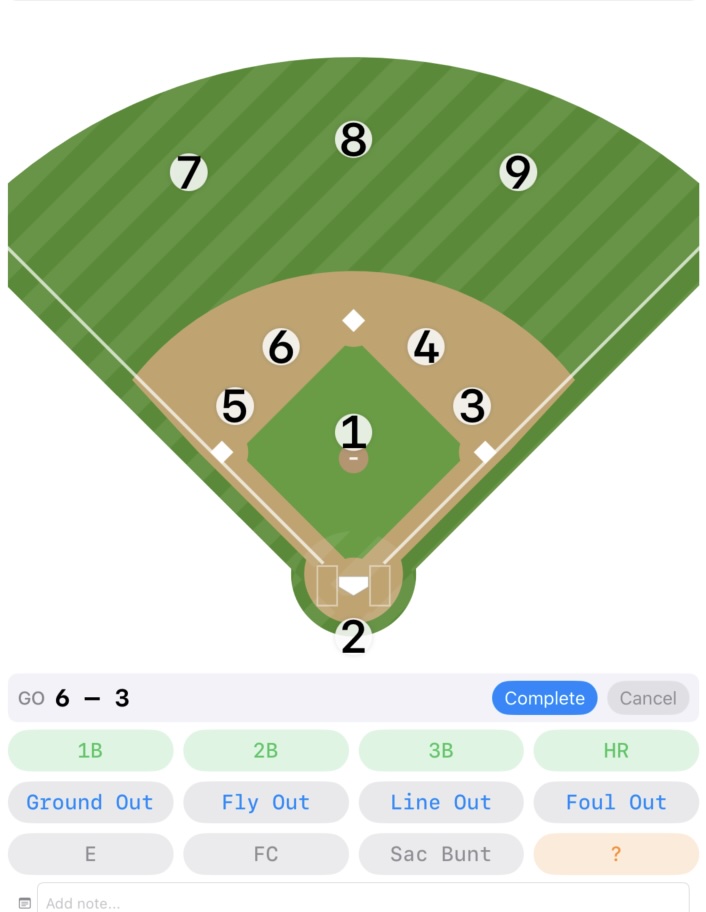
To record a standalone error, tap Error in the outcome grid. BaseballScorer then displays the fielder selection interface — tap the number of the fielder who committed the error.
For a chain with a mid-sequence error, use the ground out flow instead and tap the “E” toggle before tapping the fielder who erred. The toggle arms once, the next fielder tap is flagged as the error fielder, and the toggle auto-disarms. Repeat for additional errors. If you flag the last fielder in the chain, the app asks “Did the batter reach base?” — Yes converts the at-bat to an error result; No keeps it as a ground out (the chain still retired the batter).
The scorecard cell shows the error notation — E6 for a standalone, 6-E4-3 for a mid-chain error — with a green background when the batter reached, and the batter’s path traced on the mini diamond.